

Why Are Solder Balls Produced During SMT Reflow Soldering?
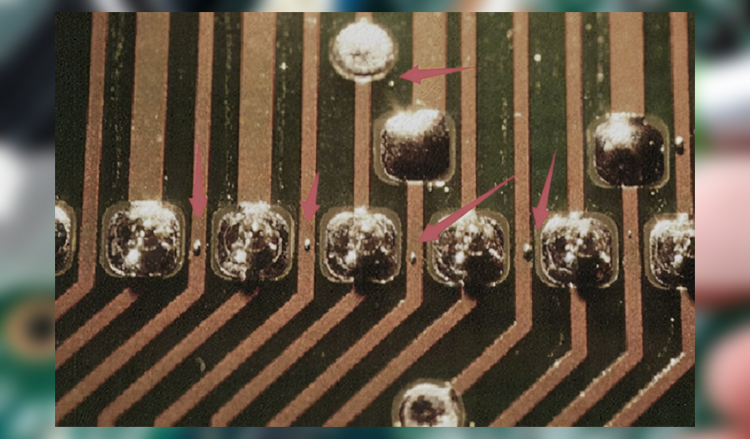
Solder balls are one of the common soldering defects that may occur during SMT reflow soldering. They appear as small, spherical particles of solder that remain on or around the PCB surface after reflow. Although a small number of solder balls may not immediately cause electrical failure, loose solder particles can become a reliability concern if they move during product operation and create an unintended electrical connection.
So, why are solder balls produced during SMT reflow soldering? Understanding their causes can help PCB assembly manufacturers take effective preventive measures.
What Are Solder Balls?
Solder balls are small, spherical particles of solder that remain on the PCB surface after the soldering process. They are different from solder joints, which are intentionally formed between component terminals and PCB pads.
During reflow soldering, the solder powder in solder paste melts and combines to form solder joints. Under unfavorable process conditions, however, some solder particles may separate from the main solder paste deposit and solidify independently as small solder balls.
Solder balls may appear around component terminals, between closely spaced pads, underneath components, or in other areas of the PCB surface.
What Causes Solder Balls During SMT Reflow Soldering?
Several factors can contribute to solder ball formation during SMT assembly.
1. Excessive or Improper Solder Paste Printing
Solder paste printing is one of the most important factors affecting solder ball formation.
If too much solder paste is deposited on a PCB pad, the excess solder paste may spread during reflow and separate from the main solder joint, forming solder balls. Poor stencil design, excessive stencil thickness, oversized apertures, or unstable printing parameters can all contribute to excessive solder paste deposition.
Printing alignment is also important. If solder paste is deposited outside the intended pad area, isolated solder particles may remain on the PCB surface after reflow.
Therefore, stencil design, solder paste volume, printing alignment, and printing consistency should be carefully controlled.
2. Poor Solder Paste Condition
The condition of the solder paste can also affect solder ball formation.
Solder paste contains solder alloy powder and flux. If the paste is improperly stored, exposed to unsuitable environmental conditions, or used beyond its recommended working time, its printing and reflow characteristics may deteriorate.
Poor paste release from the stencil or inconsistent solder paste deposition can increase the possibility of solder particles separating during reflow.
Solder paste should therefore be stored, handled, and used according to the manufacturer's specifications.
3. Improper Reflow Temperature Profile
An unsuitable reflow temperature profile can also contribute to solder ball formation.
During reflow, the solder paste needs to undergo controlled heating, melting, wetting, and cooling. If the temperature rises too quickly, the flux and volatile components in the solder paste may release gases rapidly. This can cause solder paste to spatter or separate and may result in solder ball formation.
An unsuitable soak stage or inadequate flux activation may also affect solder behavior during reflow.
For this reason, the reflow profile should be properly established according to the solder paste specifications, PCB design, and component requirements.
4. Moisture in PCB or Components
Moisture can increase the risk of soldering defects, particularly when moisture is trapped in materials and rapidly turns into vapor during heating.
However, moisture should not be considered the only or primary cause of solder balls. The actual risk depends on the PCB material, component packaging, storage conditions, and reflow process.
For moisture-sensitive components and PCBs that have been exposed to unsuitable storage conditions, appropriate handling and baking procedures should be followed according to the applicable material and component requirements.
5. Oxidation or Contamination
Oxidation and contamination on PCB pads or component terminals can affect solder wetting and solder paste behavior.
Contaminants such as oil, dust, and other residues may prevent uniform solder wetting and contribute to abnormal solder flow during reflow. Proper material storage, handling, and cleanliness control are therefore important for reducing soldering defects.
6. Improper Manual Soldering or Rework
Solder balls can also be generated during manual soldering or rework.
If excessive solder is applied, the soldering iron is used improperly, or molten solder splashes during rework, small solder particles may remain on the PCB surface.
Operators should use appropriate soldering techniques and apply only the required amount of solder during manual rework. After rework, the PCB should be properly inspected and cleaned when necessary.
How to Prevent Solder Balls in SMT Assembly
To reduce solder ball formation, PCB assembly manufacturers should control the entire SMT process rather than relying on a single corrective measure.
1. Optimize Stencil Design and Solder Paste Printing
The stencil thickness and aperture dimensions should be designed according to the PCB pad geometry and component package. Solder paste volume should be carefully controlled, particularly for fine-pitch components.
The solder paste printer should also maintain accurate alignment and stable printing parameters to ensure consistent deposits.
2. Properly Store and Handle Solder Paste
Solder paste should be stored within the temperature and environmental conditions specified by the manufacturer. Its shelf life, handling time, and working conditions should also be controlled.
Using solder paste correctly helps maintain stable printing and reflow performance.
3. Optimize the Reflow Temperature Profile
The reflow profile should be established based on the solder paste manufacturer's recommendations and the requirements of the PCB assembly.
The heating rate, soak period, peak temperature, time above liquidus, and cooling rate should be properly controlled. An optimized profile helps the solder paste melt and wet the joining surfaces more consistently while reducing the risk of solder spatter and solder ball formation.
4. Control PCB and Component Storage Conditions
PCBs and electronic components should be stored and handled properly to minimize exposure to moisture, oxidation, dust, and other contaminants.
For moisture-sensitive materials, manufacturers should follow the relevant storage, floor-life, and baking requirements.
5. Improve Rework Procedures
Manual soldering and rework should be performed by trained operators using appropriate tools and techniques. Excessive solder should be avoided, and solder particles generated during rework should be removed before the PCB proceeds to the next production stage.
What Is the Difference Between Solder Balls and Solder Dross?
Solder balls and solder dross are different phenomena and should not be treated as the same defect.
Solder balls are small spherical solder particles that may remain on the PCB after SMT reflow soldering or manual rework. They are usually associated with solder paste printing, reflow conditions, solder paste behavior, or rework processes.
Solder dross, on the other hand, is mainly an oxide-rich by-product that forms on the surface of molten solder. It is particularly associated with wave soldering and other processes involving molten solder. Dross is not simply another name for solder balls.
Understanding this distinction is important when analyzing soldering defects and determining the appropriate corrective action.
Why Should Solder Balls Be Controlled?
Solder balls may affect PCB assembly reliability if they remain loose on the board.
A loose solder particle can move because of vibration, shock, or handling during the product's service life. If it becomes trapped between conductive pads, component terminals, or other electrical structures, it may potentially cause an unintended electrical connection or short circuit.
For high-density PCB assemblies, the risk can be more significant because the spacing between conductive features is smaller. Therefore, controlling solder ball formation is particularly important for products that require high electrical and long-term reliability.
Conclusion
Solder balls are a common soldering defect that can occur during SMT reflow soldering. They may be associated with excessive or improperly deposited solder paste, unsuitable solder paste conditions, an improper reflow temperature profile, moisture, oxidation or contamination, and inappropriate manual rework.
To reduce solder ball formation, PCB assembly manufacturers should optimize stencil design and solder paste printing, properly manage solder paste and PCB materials, control the reflow temperature profile, and establish standardized rework procedures.
By maintaining stable SMT process parameters and effective material management, manufacturers can reduce soldering defects, improve PCBA quality, and enhance the long-term reliability of electronic products.