

Why Are Green PCBs More Common?
Open a router, an old radio, or a television, and you will often find a green printed circuit board (PCB) inside. Its traces resemble tiny streets, while chips, resistors, and capacitors form a miniature electronic city.
These devices perform very different jobs, yet their circuit boards often share the same color. Why are green PCBs so common?
The answer comes down to a combination of practical benefits and established manufacturing habits. Green solder mask provides useful visual contrast, works with familiar production and inspection processes, and is often an economical default.
The familiar green surface usually comes from the solder mask, a protective coating applied over the board’s outer copper circuitry. It is not typically the natural color of the underlying board material.
A common PCB substrate, FR-4, consists of glass fiber and epoxy resin. Copper forms the conductive pathways, while the solder mask covers selected areas of the outer surface. Openings leave solder pads and electrical contacts exposed where connections are needed.
This coating helps protect copper traces from oxidation and contamination. It also reduces the risk of solder bridges—unwanted connections that form when solder joins adjacent pads. Think of it as a protective jacket with carefully positioned openings: the circuitry stays covered, while connection points remain accessible.
Green is simply the most familiar color for this layer. Red, blue, black, white, and other solder mask colors are also available.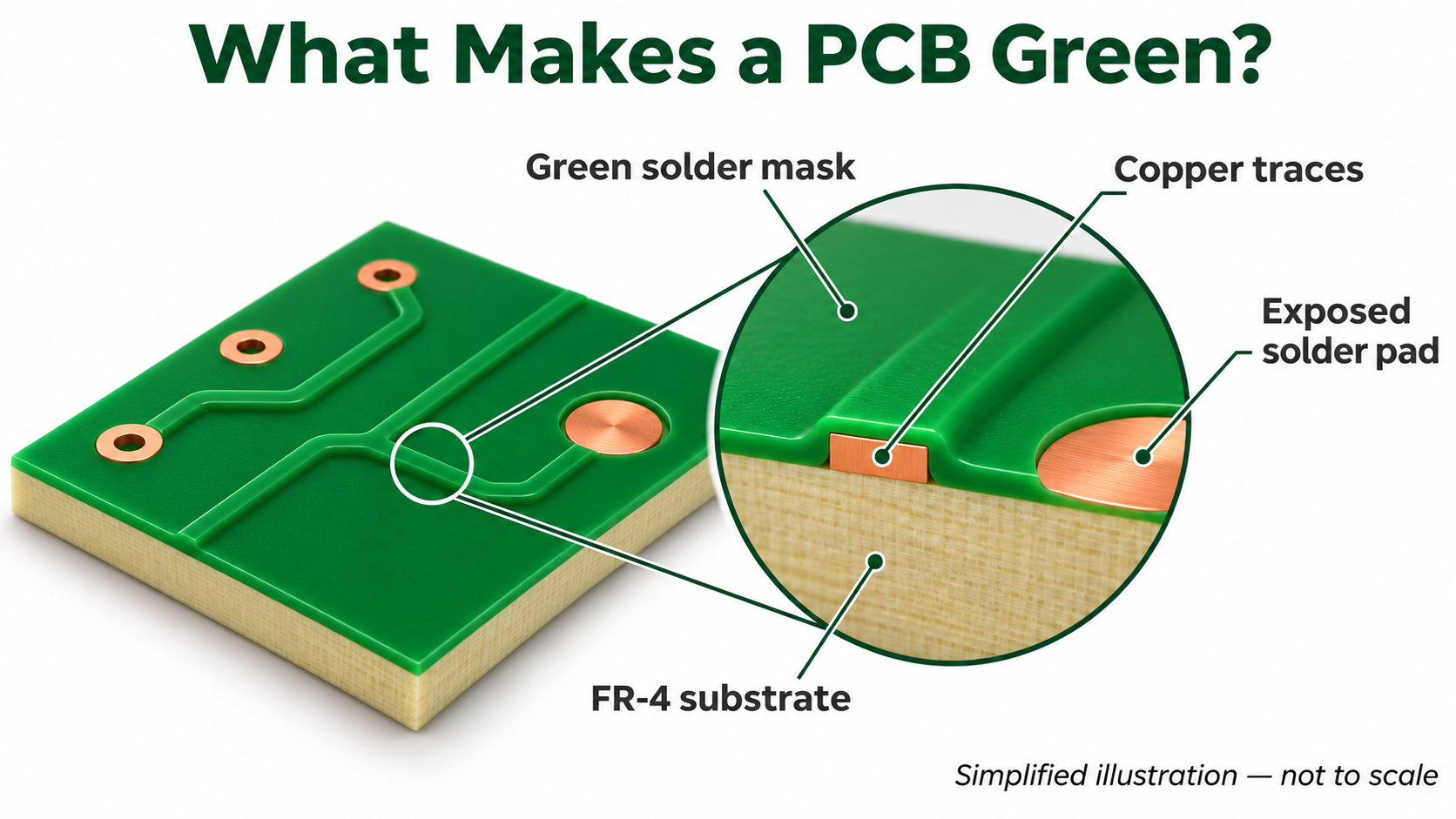
The green color comes from the solder mask covering the outer copper circuitry. This simplified illustration is not to scale.
One reason green has remained popular is that it provides a practical background for inspection.
Checking a circuit board involves more than confirming that every component is present. Inspectors need to distinguish small solder joints, read component markings, and identify possible assembly defects. Green solder mask generally provides useful contrast with white printed labels and metallic solder joints.
The visibility of underlying traces can also vary with the coating’s color and opacity. On some black boards, these details are harder to distinguish, making suitable lighting and inspection settings particularly important.
However, the explanation should not be reduced to “green is easier on the eyes.� Inspection quality also depends on surface gloss, coating thickness, lighting, and equipment settings. Color is only one part of the picture.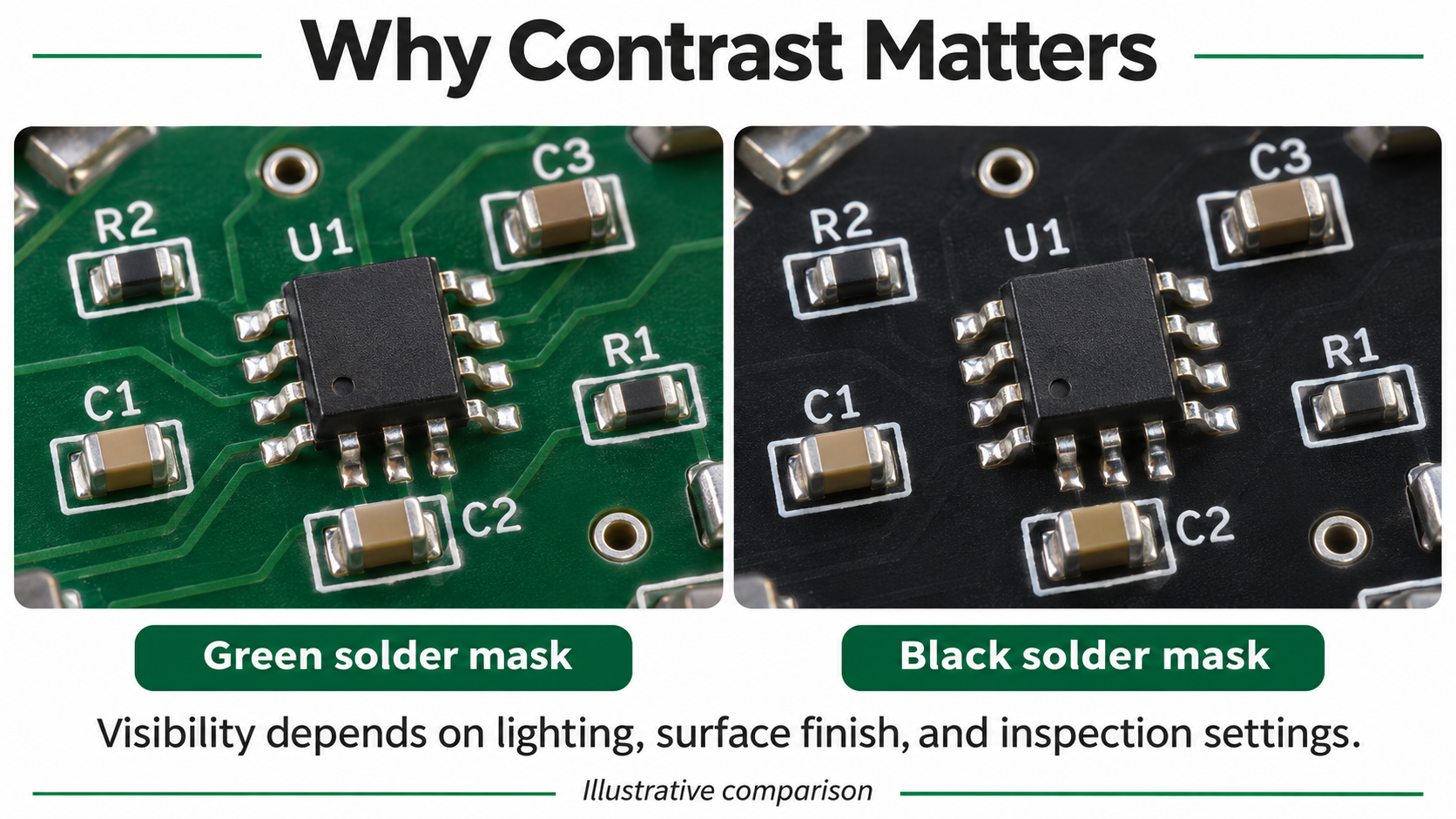
This illustrative comparison shows how solder mask color can affect visual contrast. Actual visibility depends on the materials and inspection conditions.
Manufacturing provides another part of the explanation. Solder mask color can involve differences in material formulation and processing requirements, so choosing a color is not always purely an aesthetic decision.
During production, manufacturers create precise openings in the solder mask. Some designs also require narrow strips of mask between adjacent solder pads. These strips, often called solder mask dams, help reduce the risk of solder bridging during assembly.
The ability to form these small features depends on the material and manufacturing process. Different solder mask formulations can have different processing limits, which is why designers should check their manufacturer’s specifications before choosing a color for a densely packed board. Green benefits from a long history of widespread use. Manufacturers have accumulated extensive experience with green solder mask, and inspection systems have been developed and optimized around it.
That familiarity has practical value. A process that is already well understood is easier to repeat consistently. When green meets a product’s requirements, there may be little reason to choose something else.
Cost can reinforce this preference, although green PCBs are not always cheaper than boards in other colors.
Some manufacturers treat green as the standard option and charge more for alternatives. Others include several colors in their standard pricing. The difference depends on the supplier, its production setup, and the details of the order.
For that reason, green is best described as a commonly economical and established choice. Whether another color costs more must be checked against the actual quotation.
So why choose a different PCB color at all?
Different products have different priorities. A distinctive board color can support a brand’s appearance, help identify a product revision, or complement a visible electronic assembly. A black board, for example, may be selected to match a product’s overall design.
White solder mask can serve a more specific purpose in LED lighting. Its ability to reflect visible light can be useful when the circuit board forms part of the product’s optical design.
These are practical choices, but color alone does not establish a board’s quality. A black PCB is not automatically more advanced, and a green PCB is not automatically more reliable. Material selection, circuit design, manufacturing control, and assembly quality all deserve closer attention than appearance.
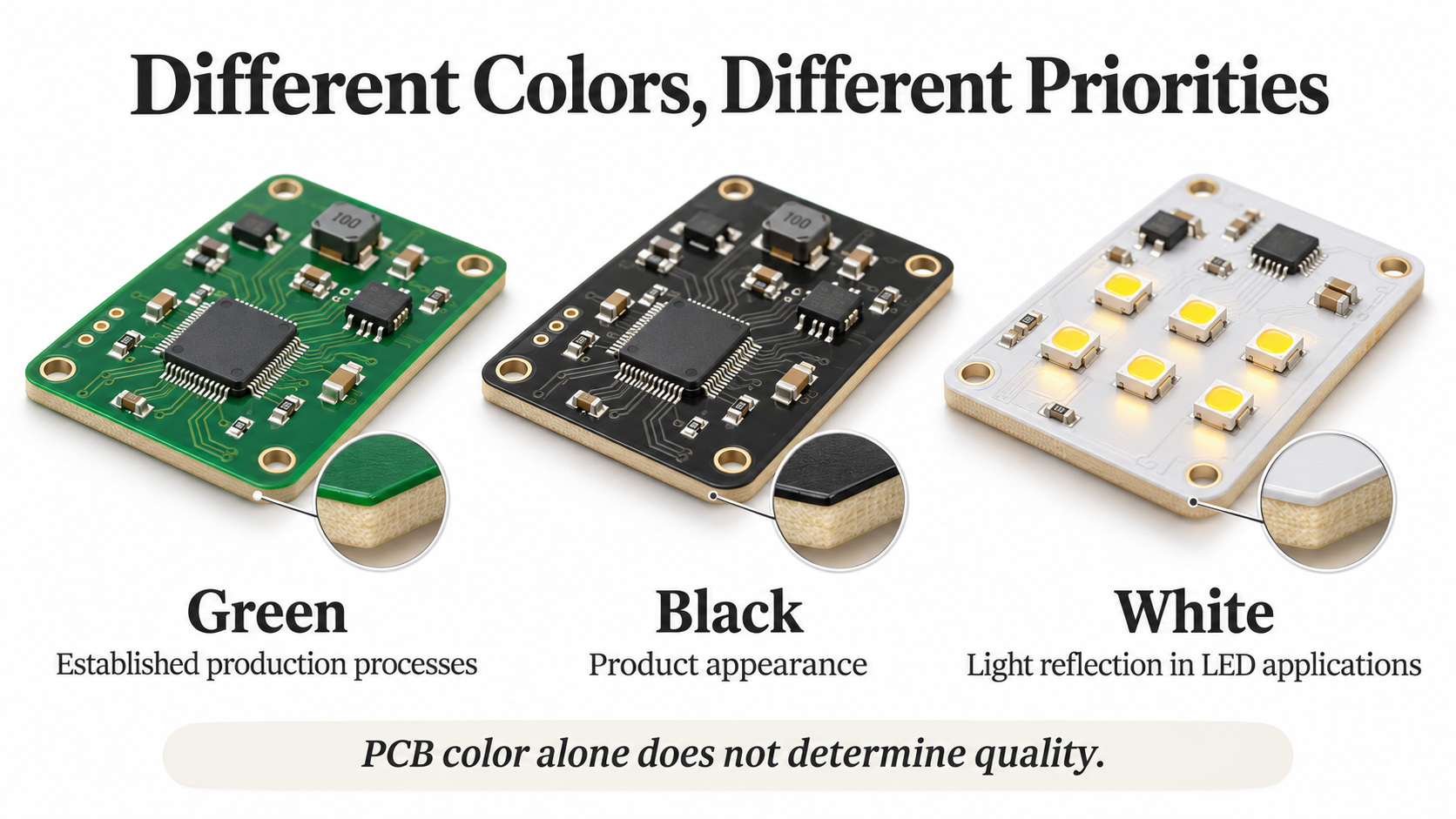
PCB colors can support different manufacturing, visual, and optical priorities. They are not quality ratings.
The next time you see a green circuit board, take a closer look at its familiar coating. It helps protect the copper circuitry, supports reliable soldering, and reflects years of manufacturing experience.
Green became the electronics industry’s familiar backdrop through a combination of visibility, established processes, and practical economics. Behind an ordinary-looking color lies a series of decisions about how to build circuit boards efficiently and consistently.